
China has a vast territory and rich water resources. The water quality varies greatly due to different regions. If the raw water is well water, the organic load will not be very large; If it is surface water (lake water, river water or reservoir water), it may contain high levels of organic matter, and the composition and quantity of organic matter may be affected by seasonal changes; Municipal water supply (tap water) is usually treated with chlorine. Before chlorine removal, the content of microorganisms is relatively low, and their growth is usually inhibited.
Generally, the configuration mode of purified water equipment system varies according to different regions and water sources. The purified water preparation system should analyze and calculate according to different raw water quality conditions, and then configure corresponding components to treat each index to the allowable range in turn. The main configuration of purified water preparation system in China at present is shown in Figure 3-1, but it is not limited to these types.
It should be mentioned here that the raw water quality should meet the drinking water standard before it can be used as the starting water for pharmaceutical water or purified water. If the raw water does not meet the drinking water standard, the raw water should be treated to the drinking water standard first, and then become the purified water meeting the requirements of the drug standard. The purified water system needs regular disinfection and water quality monitoring to ensure that the water at all points of use meets the requirements for purified water in the Pharmacopoeia.

Nowadays, many products are made of plastic by injection molding. Nitrogen is introduced into the plastic part during the forming and cooling process, and the inert protection of nitrogen is used to reduce the deformation of the finished plastic part caused by stress, so as to obtain a stable and high-precision size of the plastic part. In the industry, this is called nitrogen assisted injection, also known as nitrogen pressure maintaining.
In the process of injection molding, the purity of nitrogen charged should be 99.99% or above. At the same time, the pressure varies according to different manufacturers, and generally requires a pressure of 1.5MPa or more. If bottled nitrogen is used, the air should be changed frequently, and the operation is still troublesome, so it is recommended to use the on-site nitrogen generation system. As long as pure compressed air enters the nitrogen generation system, high-purity nitrogen can be obtained, and then connected to the nitrogen pressurization system to increase the required pressure of nitrogen.
Features of nitrogen generator:
(1) Convenient and fast nitrogen production
Advanced technology and unique air distributor make the air distribution more uniform. By using carbon molecular sieve efficiently, qualified nitrogen can be obtained in about 20 minutes.
(2) Easy to use
The equipment is compact in structure and skid mounted as a whole. It occupies a small area and does not need capital construction investment. It only needs to be connected to the power supply on site to produce nitrogen.
(3) Integrated design to realize automatic operation
PLC control fully automatic operation, nitrogen flow, pressure and purity can be adjusted and displayed online in real time, without special personnel on duty.
(4) More economical than other nitrogen supply methods
With air as raw material, the energy consumption is only the electric energy consumed by air compressor and cold dryer. It has the advantages of low operation cost, low energy consumption and high effic

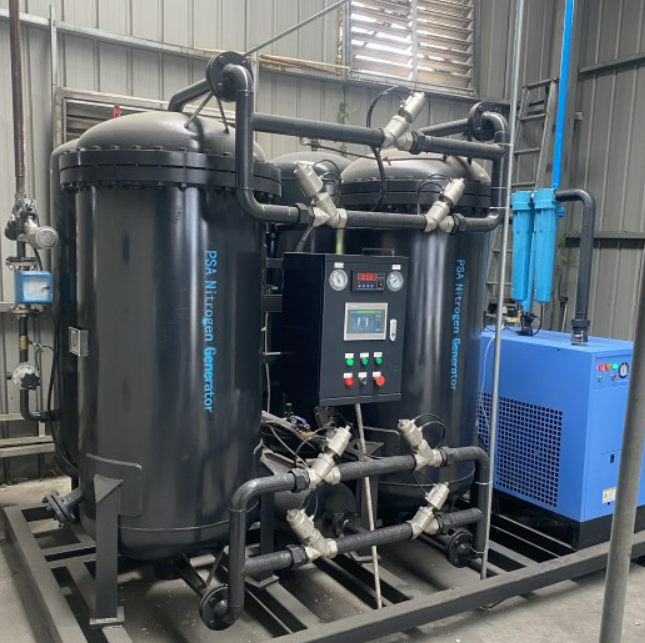
According to the principle of pressure swing adsorption, the nitrogen generator uses high-quality carbon molecular sieve as adsorbent to produce nitrogen from air under certain pressure. The purified and dried compressed air is adsorbed under pressure and desorbed under reduced pressure in the adsorber. Due to the aerodynamic effect, the diffusion rate of oxygen in the micropores of carbon molecular sieve is much higher than that of nitrogen. Oxygen is preferentially adsorbed by carbon molecular sieve, and nitrogen is enriched in the gas phase to form finished nitrogen. After that, the adsorbent will desorb the adsorbed oxygen and other impurities to realize regeneration. Generally, two adsorption towers are set in the system. One tower adsorbs nitrogen and the other tower desorbs and regenerates. The PLC program controller controls the opening and closing of the pneumatic valve to make the two towers cycle alternately, so as to achieve the purpose of continuous production of high-quality nitrogen. The whole system consists of the following components: compressed air purification assembly, air storage tank, oxygen and nitrogen separation device, and nitrogen buffer tank.
1、 Compressed air purification module the compressed air provided by the air compressor is first introduced into the compressed air purification module. Most of the oil, water and dust are removed by the pipeline filter, and then further removed by the freeze dryer, oil and dust by the fine filter, and further purified by the following ultra fine filter. According to the working conditions of the system, a set of compressed air degreaser is specially designed to prevent possible micro oil penetration and provide full protection for carbon molecular sieve. Well designed air. The purification assembly ensures the service life of the carbon molecular sieve. The clean air treated by this assembly can be used for instrument air.
2、 Air storage tank
The function of the air storage tank is to reduce the air flow pulsation and play a buffer role; So as to reduce the system pressure fluctuation and make the compressed air pass through the compressed air purification assembly smoothly, so as to fully remove the oil-water impurities and reduce the load of the subsequent PSA oxygen and nitrogen separation unit. At the same time, during the work switching of the adsorption tower, it also provides PSA oxygen and nitrogen separation unit with a large amount of compressed air required for rapid pressure rise in a short time, so that the pressure in the adsorption tower quickly rises to the working pressure, ensuring the reliable and stable operation of the equipment.
3、 There are two adsorption towers a and B equipped with special carbon molecular sieve in the oxygen nitrogen separation unit. When the clean compressed air enters the inlet end of tower a and flows through the carbon molecular sieve to the outlet end, O2, CO2 and H2O are adsorbed by it, and the product nitrogen flows out from the outlet end of the adsorption tower. After a period of time, the carbon molecular sieve in tower a is saturated. At this time, tower a automatically stops adsorption, and the compressed air flows into Tower B for oxygen absorption and nitrogen production, and the molecular sieve of tower a is regenerated. The regeneration of molecular sieve is realized by rapidly lowering the adsorption tower to atmospheric pressure to remove the adsorbed O2, CO2 and H2O. The two towers alternately perform adsorption and regeneration, complete oxygen and nitrogen separation, and continuously output nitrogen. The above processes are controlled by the programmable logic controller (PLC). When the nitrogen purity at the gas outlet reaches the set value, the PLC program will open the automatic vent valve to vent the unqualified nitrogen automatically, so as to ensure that the unqualified nitrogen does not flow to the gas consumption point. Noise shall be reduced to less than 75dBA during gas venting.
4、 Nitrogen buffer tank
The nitrogen buffer tank is used to balance the pressure and purity of nitrogen separated from the nitrogen oxygen separation system and ensure the stability of continuous supply of nitrogen. At the same time, after the work switching of the adsorption tower, it recharges part of its own gas into the adsorption tower, which not only helps the adsorption tower boost pressure, but also plays a role in protecting the bed, and plays a very important auxiliary role in the process of equipment operation.
Nitrogen generator, nitrogen generator, pressure swing adsorption nitrogen generator, high purity nitrogen generator, nitrogen generating device, nitrogen generating system, nitrogen generating equipment, nitrogen generating unit, nitrogen system, PSA nitrogen generating unit, PSA nitrogen generating system, PSA nitrogen generating device, PSA nitrogen generating equipment, nitrogen equipment, air separation nitrogen generator, industrial nitrogen generator, high purity nitrogen generator, industrial nitrogen generating device, industrial nitrogen generating system, industrial nitrogen generating equipment Industrial nitrogen production equipment.
5 cubic nitrogen generator, 10 cubic nitrogen generator, 20 cubic nitrogen generator, 30 cubic nitrogen generator, 40 cubic nitrogen generator, 50 cubic nitrogen generator, 60 cubic nitrogen generator, 80 cubic nitrogen generator, 100 cubic nitrogen generator, 120 cubic nitrogen generator, 150 cubic nitrogen generator, 180 cubic nitrogen generator, 200 cubic nitrogen generator, 300 cubic nitrogen generator, 400 cubic nitrogen generator, 500 cubic nitrogen generator, 600 cubic nitrogen generator, 800 cubic nitrogen generator, 1000 cubic nitrogen generator 1200 m3 nitrogen generator, 1500 m3 nitrogen generator, 2000 m3 nitrogen generator and 3000 m3 nitrogen generator.
Small and medium-sized nitrogen generator, mobile nitrogen generator, air nitrogen generator, and raw air nitrogen generator. The company can provide nitrogen with output of 3-3000nm3/h and purity of 95%--99.9995%, which can be widely used in chemical, electronic, textile, coal, petroleum, natural gas, medicine, food, glass, machinery, powder metallurgy, magnetic materials and other industries. Wide application range: protective gas for metal heat treatment process, gas for chemical industry production and nitrogen filling and purification of various storage tanks and pipelines, gas for rubber and plastic products production, oxygen discharging and fresh-keeping packaging in food industry, purification and covering gas in beverage industry, nitrogen charging and oxygen discharging of nitrogen charging packaging and containers in pharmaceutical industry, protective gas for electronic components and semiconductor production process in electronic industry, etc. The purity, flow and pressure are stable and adjustable to meet the needs of different customers.

Industrial nitrogen generator is a special high-purity nitrogen generator in the industrial field. It is a nitrogen generator designed and manufactured according to pressure swing adsorption technology. With air as raw material, high-quality carbon molecular sieve as adsorbent, pressure swing adsorption principle (PSA) and molecular sieve full of micropores are used to selectively adsorb air to achieve the purpose of oxygen and nitrogen separation. The nitrogen generating device has the characteristics of simple process flow, high automation, fast gas production (15 ~ 30 minutes), low energy consumption, nitrogen generator product purity can be adjusted according to users' needs in a large range, convenient operation and maintenance, low operation cost, strong device adaptability, etc., so it is more and more welcomed by small and medium-sized nitrogen users. The nitrogen generation device shall be used in a special chamber with good ventilation, small mineral dust, no ponding or dripping, or in a relatively clean roadway.
Now let's talk about the precautions for safe use of nitrogen generation device:
1. Before starting the machine, carefully check the whole nitrogen making device to ensure that no tools, parts or other objects are left in the air compressor.
2. When starting the nitrogen generation device, the emptying valve shall be in the emptying state to avoid overpressure of the air compressor.
3. No welding operation shall be carried out near the oil circuit system, and no pressure vessel shall be modified by welding or other methods.
4. Regularly check the reliability of safety devices (such as safety valves).
5. The maintenance of the nitrogen generating device can only be carried out under the condition of shutdown and power failure.

When it comes to nitrogen generators, everyone must be familiar with them, because nitrogen generators are still widely used in many industries. So what are the requirements for the installation site and environment when the nitrogen generator is installed? The following is a brief introduction to the majority of users.
Each equipment of the nitrogen generator shall be deployed in sequence according to the process flow. The user needs to provide the dimensional drawing of the equipment installation plant and the positions of the air inlet and the nitrogen outlet of the molded articles, and plan the deployment and connection diagram of the complete set of nitrogen generator equipment according to the essential site conditions.
Nitrogen generator system equipment usually has no basic site requirements. As long as the plant is flat and flat, the installation conditions can be met. However, the air compressor and compressed air drying equipment with larger specifications shall be implemented according to the requirements of the manufacturer. For the sake of equipment maintenance, cleanness and simplicity, it is better to make a flat table 10cm higher than the ground at the location of air compressor, drying equipment, nitrogen generator and nitrogen purification device.
Each equipment is usually deployed along the wall of the plant. The air compressor and the cold dryer shall be placed at the upper air outlet or a place with good ventilation. If there is no air storage tank behind the air compressor, the interval between the air compressor and the cold dryer shall be as large as possible, and the length of the pipeline between them shall be as long as possible, so as to reduce the temperature of the contracted air through the atmospheric environment. The interval between each equipment shall be at least greater than 1m, and the interval between each equipment and the wall shall be at least greater than 0.8m. The control surface of the equipment shall face the direction of simple operation by the staff, so that the simple user can operate, care for and inspect the equipment.
The pipeline connection between equipment depends on the essential condition after the equipment is in place. It is recommended that the pipeline connection be manufactured by the user according to the demand. All pipelines shall be hard connected (threaded connection or welding) and constructed by special staff to prevent leakage.
After all process equipment is in place, the pipelines between the equipment shall be configured according to the actual situation on site. All pipelines shall be hard connected (threaded connection or welding) and constructed by special staff to prevent leakage. Copper pipe or stainless steel pipe is preferred for the pipeline between the nitrogen outlet of formed articles and the gas consumption point (New galvanized pipe is selected for the second time), and welding method is used for connection. The power supply and cooling water shall be led to the equipment site, and the distribution board and cooling water supply facilities shall be prepared.